Laník’s wartime hoarding and trading
The Glass RoomLaník’s wartime hoarding and trading transform the Landauer House’s hidden basement into a storehouse and a working economy. As Město is battered by scarcity and war, he accumulates goods, extends credit, accepts payment in kind, and sells the absent family’s furniture. His enterprise is at once a means of survival and a claim on a house that is not his: while his sister imagines the Landauers returning, Laník insists that they are gone for good and that the future belongs to whoever can make use of what remains.
The basement as storehouse
Laník and his sister inhabit the house’s margins rather than its celebrated Glass Room. Their rooms lie behind the garage; they cook and eat in the kitchens, and move through the basement, a low-ceilinged maze of laundry and storage rooms, tanks, pipes, and machinery. Electricity cables and water conduits cross the routes between rooms, while the motors that raise and lower the Glass Room’s windows sit against the front wall. The contrast is stark: above, open space and light; below, a cramped, humming infrastructure of maintenance and concealment. It is in this subterranean world that Laník keeps his stores.
His explanation to his sister turns the stockpile into a plan. They must think about what they can do “when it’s all over,” he says, though she expects the Landauers to return and life to resume as before. Laník rejects that certainty. The house, for the moment, is theirs to use, and he is already building what he calls a nest egg: stock for the future, a little capital. When his sister asks what capital means, he reduces the abstraction to its material content—stuff. The exchange makes his outlook plain: the future is not an idea but a reserve of goods kept within reach.
Stock, exchange, and opportunity
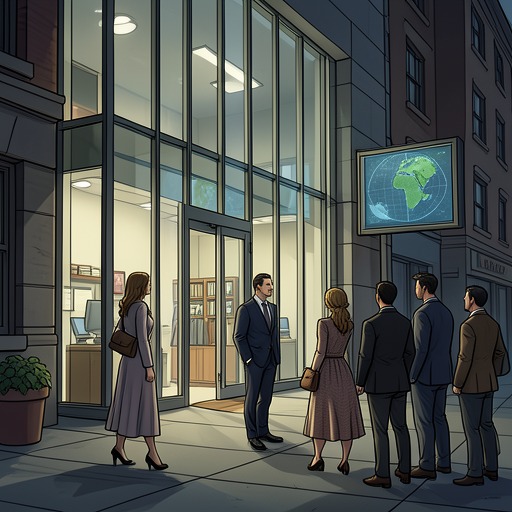
The goods in the basement acquire value as Město’s ordinary economy gives way to shortage. Cigarettes, paraffin, powdered egg, and powdered milk are carefully stored, not as a miser’s treasure but as a banker’s investment. People descend the outside stairs with stories of hardship and destitution. Laník listens, offers credit when he judges it appropriate, and accepts payment in kind. His manner is practical rather than charitable: he knows that antagonizing customers would damage the business. He urges his sister to seize opportunities, treating each exchange as a calculation made under worsening conditions.
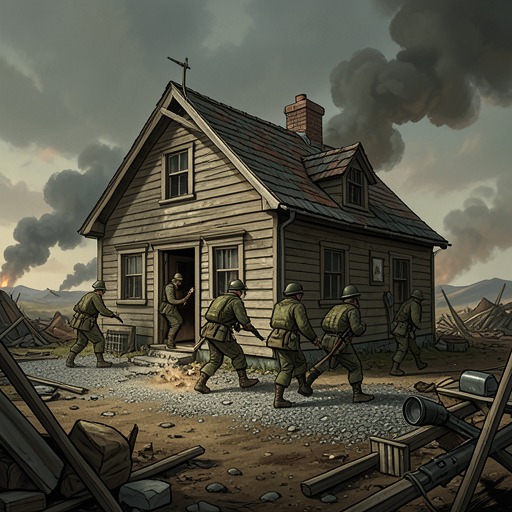
As fighting approaches, barter becomes more than Laník’s private strategy. The streets are increasingly deserted except for the machinery of war, and people search for candles, potatoes, bread, cooking paraffin, soap, matches, and cigarettes. Money has become insignificant; the city has reverted to barter. Laník instinctively knows how much bread a certain number of cigarettes will buy, or how much cake is worth a candle. His stores are thus not merely a hedge against an uncertain future: they make him a local intermediary in a city where need, rather than money, sets the terms of exchange.
That economy carries an intimate human cost. When Jana Kubecová comes for powdered milk for her baby, Laník takes her down into the basement and adds a packet of cigarettes to the exchange. Her husband has been deported to Germany for factory work near Hamburg, and she has heard nothing from him for two months. The baby is asleep at home; Jana says she cannot stay long. Laník’s offer can be read as a small accommodation to immediate need, but it is also part of his measured commerce: he understands the value of goods and the leverage scarcity gives their holder.
The house as property and opportunity
Laník’s dealings extend from stored necessities to the house itself. After hearing at the pub that the Red Army is coming, he returns to the question of the onyx wall. He expects the wall to have value and does not want it stolen, so he finally follows Viktor Landauer’s parting instruction to cover it with a partition of wood and plaster. The act protects the material feature while hiding it from view. Laník has not settled what he will do with it after the war; he imagines that it might become ashtrays, perhaps hundreds or even thousands. The speculation converts an architectural treasure into possible stock, carrying his habit of valuation from food and fuel into the house’s fabric.
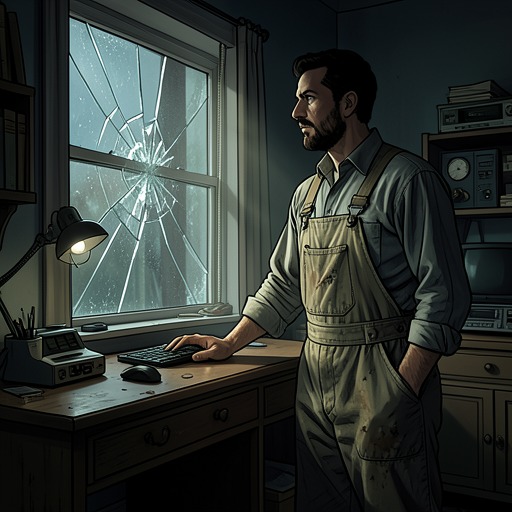
The building’s meaning changes under bombardment. Glass lies scattered across the floor, the linoleum is torn, and dirt peppers the partition concealing the onyx. Laník fixes tarpaulins over the missing windows; the Glass Room, once defined by light, is left in dusk. Against that damage, the basement’s inventories and concealed wall suggest a stripped-down economy of things that can be hidden, traded, or repurposed. The house is no longer simply the Landauers’ modern home: it is shelter, warehouse, and a reserve of potential value.
The clearest breach of the boundary between stewardship and appropriation comes when Laník and his sister take shelter in the basement during the battle and she asks what happened to the rest of the furniture. Laník says he sold it. Among the few objects left is a chair named for Liesel Landauer, a Liesel chair. His sister objects that the furniture was not his to sell and asks what will happen if the family comes back. Her question gives the transaction its moral weight: these objects belong to absent people whose return remains possible to her, even as Laník treats them as disposable assets.
The absent owners and the future
The siblings’ disagreement reveals two rival ways of living inside the Landauer House. His sister’s maternal devotion to Laník is bound up with pride in his cleverness, but she retains the certainty that the owners will return and things will be as they were. Laník instead tells her that they are never coming back and that nothing will be the same. The goods he accumulates are therefore more than practical provisions: they embody his refusal to organize the future around restoration of the old household.
When his sister wonders where the Landauers have ended up, Laník dismisses her pity. They are rich enough to escape and reach somewhere safe, he argues, so there is no reason to worry about them. She answers that it is their house after all. An explosion interrupts the dispute, and she forgets the absent family as the battle draws nearer. The exchange leaves the conflict unresolved. Laník’s trading keeps him equipped to endure a collapsing city, but his confidence in the owners’ permanent absence makes survival inseparable from taking possession of what they left behind.
The basement’s stores, the covered onyx, and the sold furniture form a single pattern: Laník converts uncertainty into inventory. His activity is resourceful, and its transactions respond to real deprivation; yet the house’s goods are not simply his to command. By placing a useful wartime economy beside the sister’s insistence on ownership and return, the narrative makes his competence morally unsettled. The future he prepares for may be one in which the Landauers’ home remains a refuge, but also one in which their absence has already been made profitable.